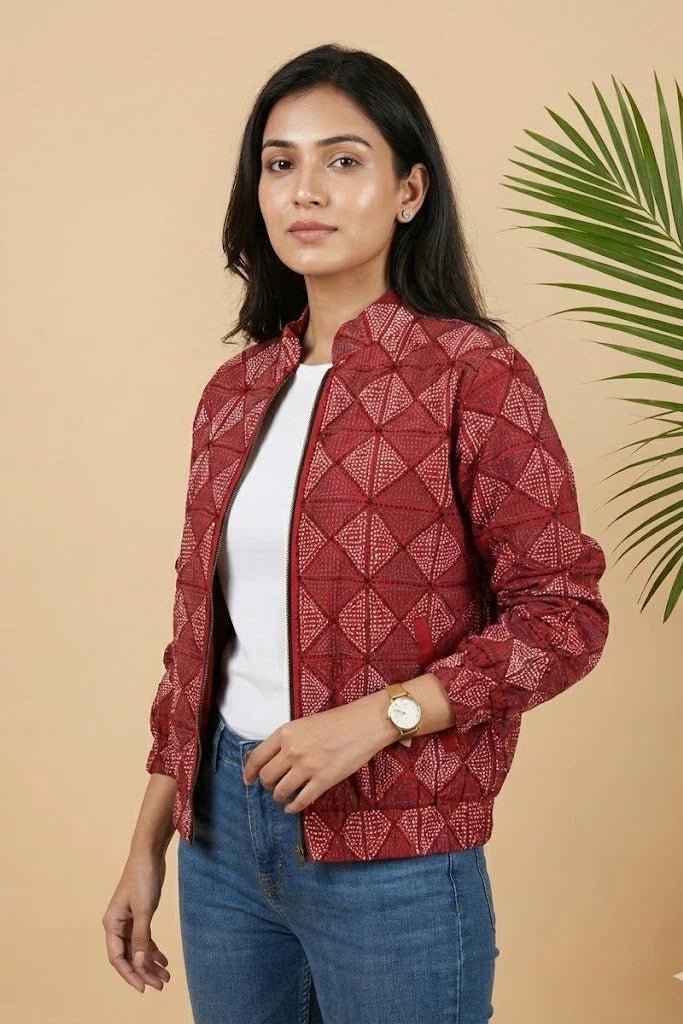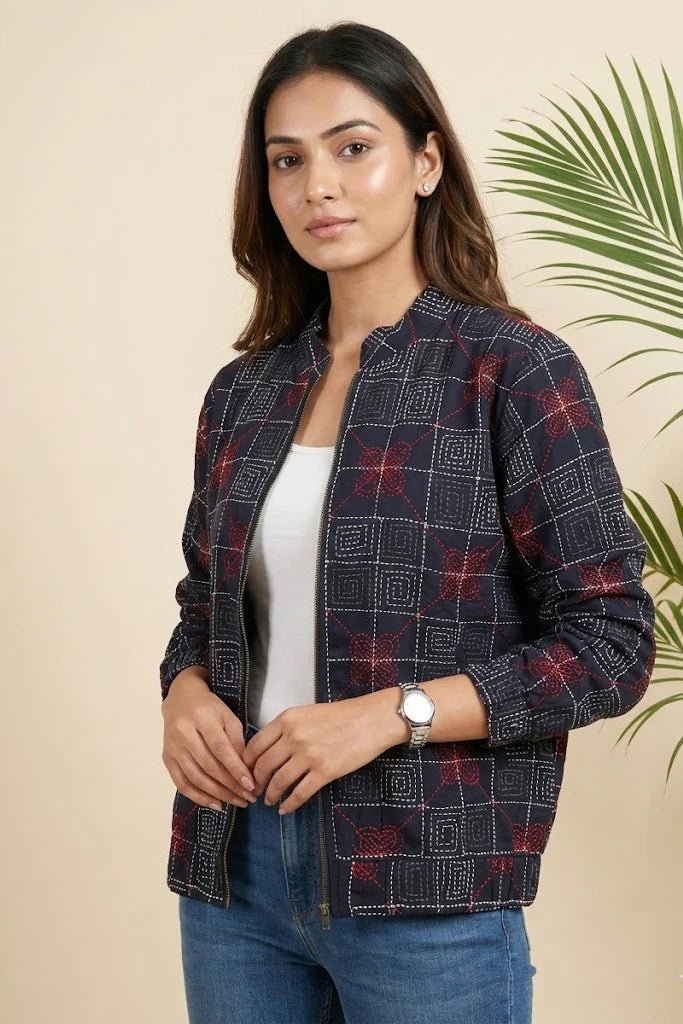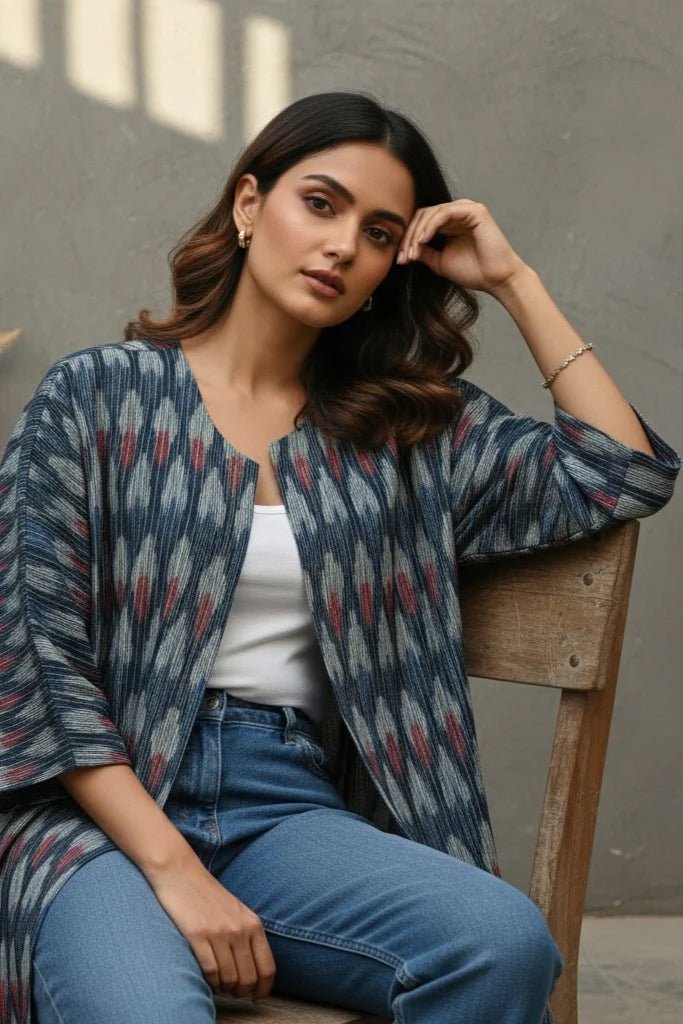
Look closely at an ikkat pattern and you will notice something unusual: the edges of every motif are slightly blurred, as if drawn with a soft pencil. That is not a flaw or a printing fault. It is the mark of how the cloth is made, and it is the easiest way to recognise the real thing.
What ikkat means
Ikkat, also spelt ikat, comes from a Malay word meaning to tie or bind, and it describes the method. In ikkat the yarn is bound in sections and dyed before the cloth is woven, so the colour is already in the thread. The pattern is not printed on the cloth. It appears as the cloth is woven.
How it is made
- The yarn is stretched out and marked in sections where each colour will go.
- Those sections are bound tightly with thread, so the dye cannot reach them.
- The yarn is dyed. Where it was bound, it keeps its original colour. The binding can be moved and the yarn dyed again to add more colours.
- The dyed yarn is set up on the loom so that the coloured sections line up to make the pattern.
- The weaver weaves the cloth. The threads settle very slightly as they are woven, which gives each motif its soft, feathered edge.
Ikkat can be done on the lengthwise threads, on the crosswise threads, or on both. When both are dyed in advance, it is called double ikkat. It takes much longer to set up, because the two sets of threads must meet exactly as the cloth is woven.
Where ikkat comes from in India
- Pochampally, Telangana. A GI-registered ikat, made in cotton, silk and silk-cotton, known for bold geometric diamonds, zigzags and stepped patterns.
- Western Odisha. The Sambalpuri ikat, in which the tie-dye method is called bandha. Traditional motifs include the conch shell, the wheel and the flower.
- Patan, Gujarat. The Patola is a famous double ikat, far finer and rarer than the others.
We mention these for context. We do not claim a region for our own pieces here. If you would like to know where a particular piece was woven, ask us on WhatsApp.
How to tell real ikkat from a print
- Look at the edges of the motifs. In ikkat they are soft and slightly feathered. In a print they are sharp and even.
- Turn the cloth over. Because the colour is in the yarn, the pattern shows on the back almost as clearly as on the front. In a print it is often paler.
- Expect small variations from one repeat to the next. They show it was set up and woven by people.
- Think about the price. Dyeing yarn in advance and weaving it takes time, and a very low price is a clue.
- Ask. A good seller can tell you how a piece was made.
For more on telling handloom from imitation, read why handloom still matters, and how to buy it well.
Wearing ikkat
- Let it be the pattern. Wear an ikkat jacket over a plain dress or a solid kurta set, and keep everything else quiet.
- Plain denim or straight trousers work well under an ikkat jacket for an everyday outfit.
- Pick one colour from the ikkat and repeat it in a bag or shoes.
- Cotton ikkat is light enough for daily wear and the office. Keep jewellery simple.
Looking after ikkat
- Always read the label first.
- Wash the first few times on their own, in cold water with a mild detergent, because dyes can bleed a little early on.
- Do not soak for long or scrub.
- Dry in shade, since strong sun fades colour.
- Iron on a medium heat, from the reverse side.
There is more in how to care for handloom, block-print and velvet pieces.
Questions people ask
Is ikkat always handloom?
No. Ikkat describes how the yarn is dyed, not how the cloth is woven. It can be woven on a handloom or on a powerloom, which is why “handloom ikkat” is worth looking for in the name or description.
Why is the pattern blurred?
Because the yarn is dyed before weaving, and the threads move very slightly into place as the cloth is woven. The blur is the signature of the technique.
What is double ikkat?
It is ikkat in which both the lengthwise and the crosswise threads are tied and dyed before weaving, so the pattern forms only when the two meet on the loom.
Ikkat in our pieces
Our listings describe these jackets and kurta sets as handloom ikkat cotton.
-
Sale!
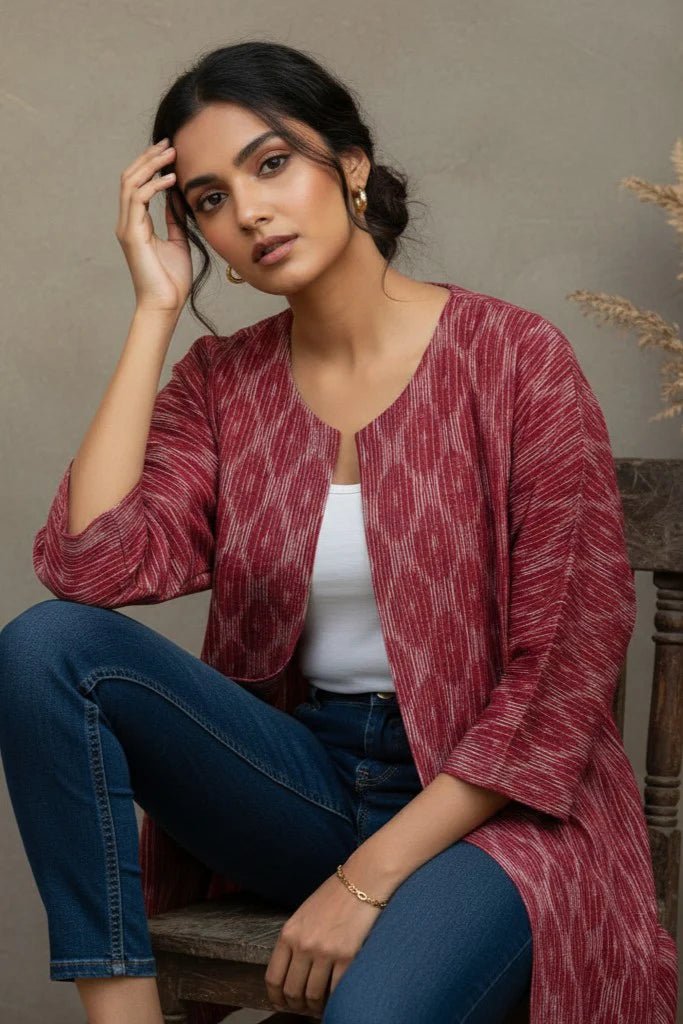
Maroon Ikkat Cotton Jacket Vivian
Original price was: ₹4,500.₹3,375Current price is: ₹3,375. Select options This product has multiple variants. The options may be chosen on the product page -
Sale!
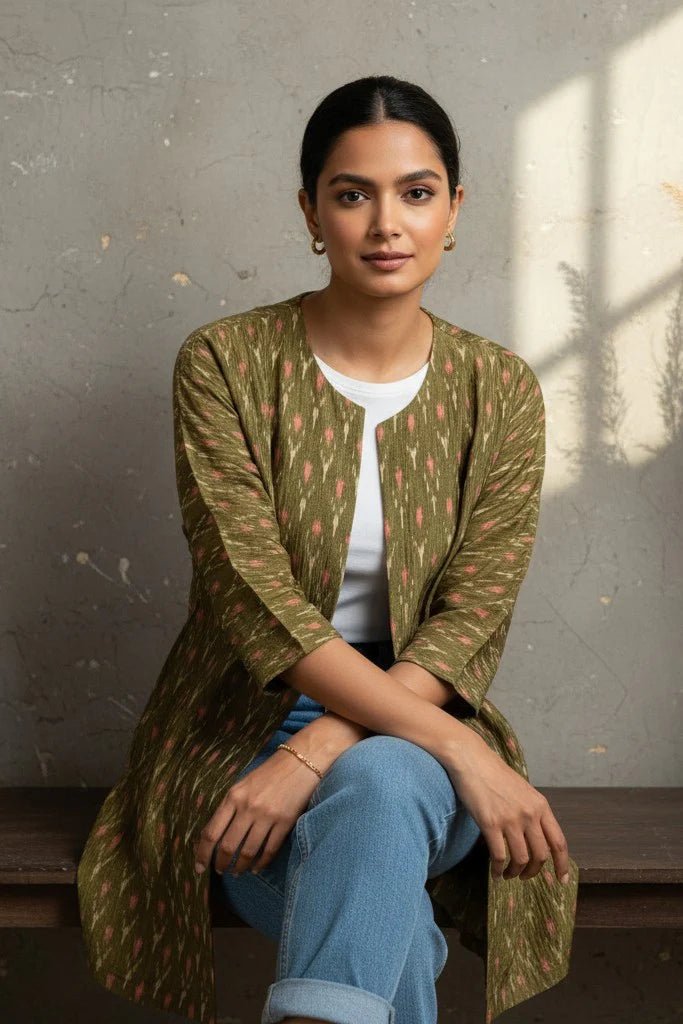
Ikkat Cotton Jacket Elle
Original price was: ₹4,500.₹3,375Current price is: ₹3,375. Select options This product has multiple variants. The options may be chosen on the product page -
Sale!
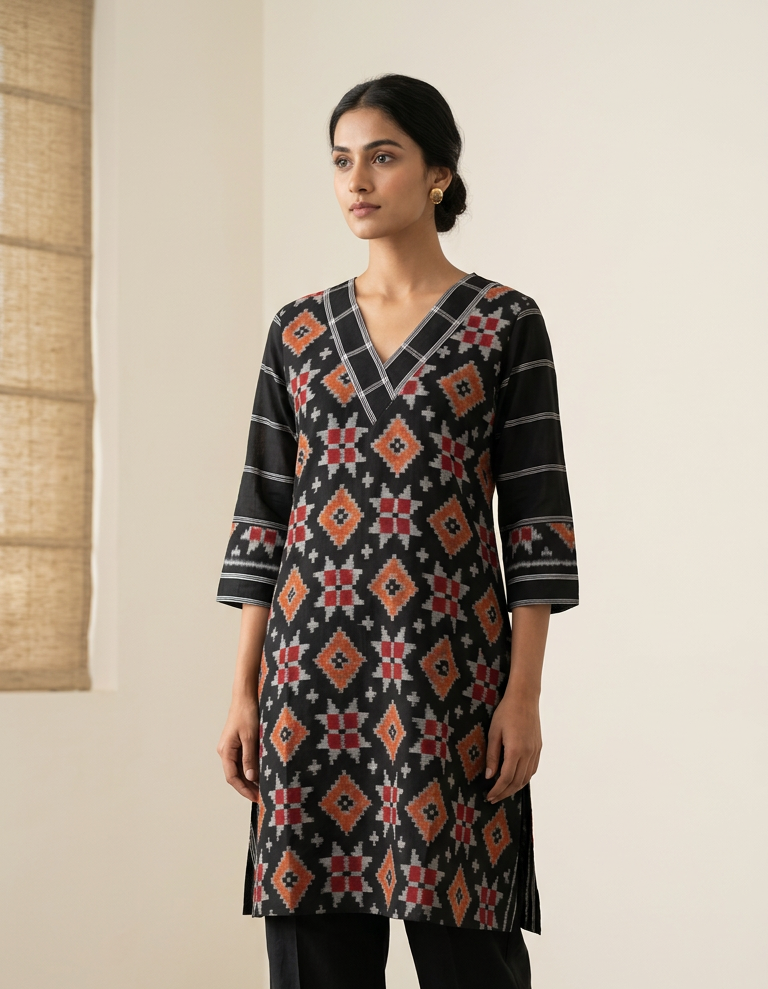
Handloom Ikkat Cotton Kurta Set Mocha
Original price was: ₹4,500.₹3,375Current price is: ₹3,375. Select options This product has multiple variants. The options may be chosen on the product page
Three more are described as double ikkat: the Yuzu dress, the Tyla dress and the Lillian reversible jacket. You will also find ikkat in the Vivian, Margot and Posy long jackets.
For a deeper look at the craft, read Teevra’s guides to Pochampally ikat and the Sambalpuri weave, or our fabric guide.